


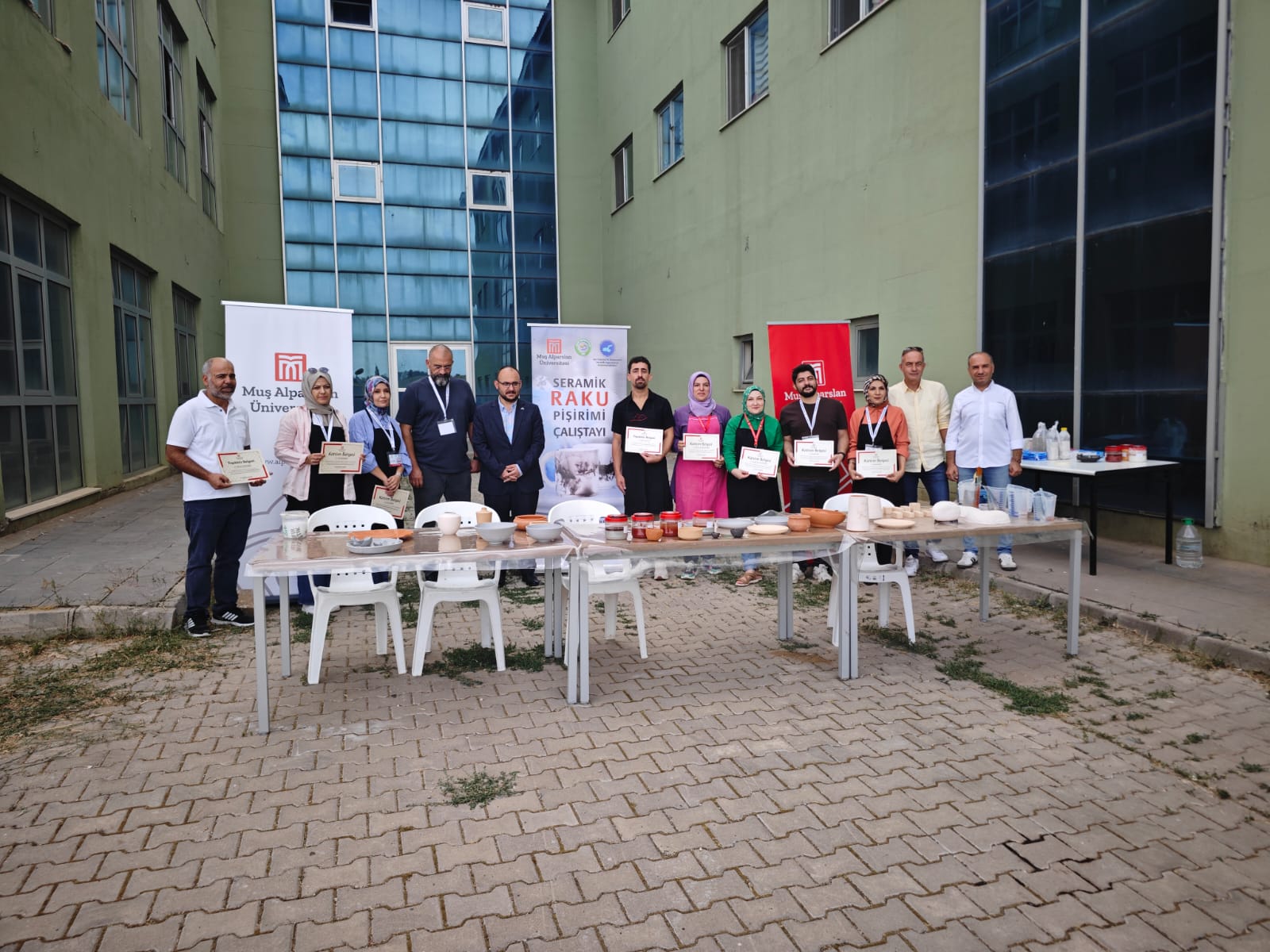

The "Ceramic Raku Firing Workshop" was organized by the Handicrafts Department of our university's Technical Sciences Vocational School (TBMYO).
The two-day workshop, held on September 4-5, was attended by Assoc. Prof. Dr. Emrah Pek and Dr. Lecturer Yeliz Erdoğan from the Department of Fine Arts Education in the Painting Education Department of Van Yüzüncü Yıl University's Faculty of Education, and Lecturer Dr. Elçin Telli Ateş from the Ceramics and Glass Design Program in the TBMYO Handicrafts Department of Iğdır University. The event was coordinated by Lecturer Emre Koç from our university's Handicrafts Department.
The workshop was opened by our Rector Prof. Dr. Mustafa Alican, Vice Rector Prof. Dr. Talat Körpınar, TBMYO Director Dr. Lecturer Fatih Şevgin, Social Sciences Vocational School Director Assoc. Prof. Dr. Mehmet Özalper, TBMYO department heads, academic and administrative staff, and students from the Handicrafts Department attended.
In his opening remarks, Rector Prof. Dr. Mustafa Alican emphasized the ancient history of ceramics and the cultural richness of such workshops in the city. He said, “The Raku firing workshop is a significant event that adds value to the artistic and cultural life of our city. Such workshops both develop our students' artistic skills and contribute to the cultural identity of our city. As a university, we will continue to support all branches of art. In this context, I would like to thank our staff and visiting academics who contributed to the workshop.”
Event coordinator Lecturer Emre Koç shared detailed information about the workshop, emphasizing the historical significance of Raku firing. Lecturer Koç stated that this technique, which began being practiced in Japan in the 16th century, maintains its value today, and offered the following information: “Raku firing is popularly practiced due to its rapid results and the impressive surface effects resulting from heat changes. There are different types of Raku firing: Naked Raku, Horsehair, and Glazed Raku. In the workshop, we will experience the ‘Glazed Raku’ technique. The works reach temperatures of approximately 1000 degrees Celsius in the kiln, where they undergo special treatments in reduction buckets to achieve their unique aesthetic appearance.”
Lecturer Koç, who detailed the Raku firing process, Koç explained, “The forms, shaped from ceramic clay suitable for Raku firing, are glazed with Raku glazes after the bisque (first firing) firing. The works are placed in the kiln and fired for approximately 2-3 hours. Once the target firing temperature is reached, the kiln door is opened, and the ceramics are removed using Raku tongs and placed in the reduction bucket. Combustible organic materials such as sawdust and newspaper are poured over the top, and the bucket lid is closed, allowing the ceramics to reduce within the bucket. Due to the sudden temperature change and the reduction environment, cracks and color transitions can occur in the glaze. Once the bucket has cooled, it is opened, and the ceramics are cleaned, freed of burnt chips, and finally, they are given their final form.”
Providing his gratitude to the participants, TBMYO Director Dr. Lecturer Fatih Şevgin, a member of the Board of Directors, said in his speech, “I would like to thank the esteemed academics who participated in our workshop, our Handicrafts Department instructor, Instructor Emre Koç, for their contributions, and all the participants. Such events increase the academic and artistic productivity of our vocational school and inspire our students. I extend my gratitude to our rector, Prof. Dr. Mustafa Alican, for his support of artistic endeavors.”
The two-day “Ceramic Raku Firing Workshop” will be a productive process for participants to gain hands-on experience and familiarize themselves with different firing techniques.
 Muş Alparslan University